
Why do oil-injected screw compressors run cooler, quieter, and more efficiently than many other types of industrial compressors?
The answer lies in one critical factor: the injected compressor oil. In modern industrial environments, oil-injected screw compressors are widely used because the oil inside the compression chamber does far more than simple lubrication. It plays several essential roles that directly affect efficiency, durability, and long-term operating costs.
From automotive manufacturing plants to electronics factories and metal processing workshops, oil-injected screw compressors have become one of the most reliable compressed-air solutions. Below are the four key functions of compressor oil and why they matter in real industrial applications.
During the compression process, a large amount of heat is generated inside the screw compressor. To control this heat, compressor oil is continuously injected into the compression chamber in the form of a fine mist.
This oil absorbs the heat of compression quickly and efficiently, keeping the discharge temperature significantly lower than in oil-free compressors. Lower operating temperatures help:
improve overall energy efficiency
reduce the risk of overheating
extend the lifespan of internal components
ensure stable operation in high-load industrial environments
This is one of the main reasons why oil-injected screw compressors are widely used in continuous-operation industries such as automotive production and metal fabrication.
Another critical function of compressor oil is lubrication. Inside oil-injected screw compressors, the male and female rotors rotate at high speed and are constantly in close contact.
The injected oil creates a protective lubricating film between the rotors, reducing friction and minimizing mechanical wear. At the same time, the oil also lubricates the bearings that support the rotors.
Because the same oil is used for both rotor lubrication and bearing lubrication, the internal structure of oil-injected screw compressors can be simpler and more compact. This design improves rotor stability and allows the compressor to operate reliably at high speeds for long periods.
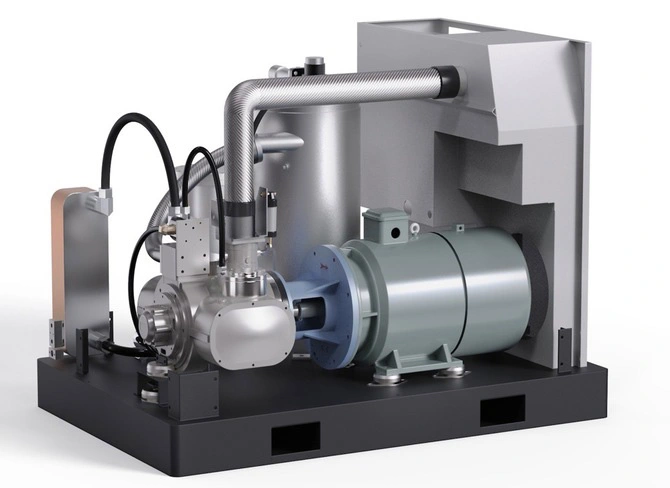
In any rotary compressor, there are always tiny gaps between the rotors and the housing. Without proper sealing, compressed air can leak backward through these gaps, reducing overall efficiency.
In oil-injected screw compressors, the injected oil forms a thin oil film that fills these micro-clearances. This oil film acts as a dynamic seal, preventing internal air leakage and improving volumetric efficiency.
As a result, the compressor can produce more compressed air while consuming less energy. For factories that operate compressors 24/7, this improved efficiency can lead to significant long-term energy savings.
Noise is another important factor in industrial environments. Oil-injected screw compressors are generally quieter than oil-free compressors, and the injected oil plays a key role in this.
The oil absorbs vibration and reduces the high-frequency noise generated during the compression process. It also helps stabilize the rotor movement, which further reduces mechanical noise.
This makes oil-injected screw compressors more suitable for factories that need a quieter and safer working environment, such as electronics manufacturing, food processing plants, and pharmaceutical production facilities.
Oil-injected screw compressors remain one of the most efficient and reliable compressed-air solutions in modern industrial operations. By providing effective cooling, lubrication, sealing, and noise reduction, compressor oil plays a vital role in ensuring stable performance and long equipment life.
Understanding these four key functions can help engineers, plant managers, and buyers choose the right screw compressor system for their specific application. As energy-efficiency standards continue to rise worldwide, high-quality oil-injected screw compressors will continue to play an important role in industrial production.
 sales@cmncompressor.com
  +86-15325678508
 English